
Has Your Marketing Evolved With Your Business?

Your business may have grown considerably over the past few years. If it has, does your marketing still give prospective customers an accurate picture of the business you are today?
At RBC Marketing, we have created a free guide for construction and trade businesses, titled “Has Your Marketing Evolved With Your Business?” It is designed to help owners and directors take a practical, honest look at whether their website, online presence and marketing activity support the type of work they want more of.
Many established businesses do not have a marketing problem in the traditional sense. They have built a strong company, developed a capable team, earned excellent reviews and taken on better projects. But their online presence is still presenting a version of the business from several years ago.
Growth can outpace marketing
Think back three to five years. Perhaps you had fewer vans, a smaller team, and a tighter service area. Maybe the business focused mainly on smaller domestic jobs, while today you are delivering larger residential projects, commercial work, or specialist services.
That kind of evolution is positive. But it often happens gradually, while the website, Google Business Profile, project gallery, and social media channels remain largely unchanged.
As a result, a prospective customer who has never heard of you may not immediately understand:
The scale of business you have built
The services or specialist work you now undertake
The areas where you want to win more work
The quality and type of projects you are capable of delivering
The experience, accreditations, reviews, and reputation behind the business
Your marketing does not need to be flashy. It simply needs to make the right information visible to the right people.
A practical six-point check
The guide walks through six areas that are worth reviewing when a construction or trade business has grown or changed direction.
1. Does your website reflect the business you have built?
A website can be technically sound and still be out of date in a commercial sense.
For example, if your business now carries out substantial extensions, commercial installations, or specialist projects, but your website mainly shows small jobs from years ago, it may attract the wrong sort of enquiry. Your strongest recent work, key services, team, accreditations, reviews, and photography should all help customers understand the business you want them to see.
This does not automatically mean you need a new website. Often, the right updates are more focused:
Add or improve key service pages
Showcase stronger and more relevant recent projects
Make testimonials and Google reviews easier to find
Update accreditations, credentials, and team information
Ensure it is simple to call or enquire from a mobile phone
The useful question is not, “How old is our website?” It’s, “Does it still help us win the work we want?”
2. Can the right customers find you in the places you want to work?
Many trade and construction companies widen their geographical reach over time. You may have started working within a short distance of your base but now operate across Sussex, Surrey, London or further afield.
The important point is to think commercially, rather than simply listing every location you could travel to. Which towns, areas or sectors offer the most valuable and profitable opportunities for your business?
If Guildford, Horsham, Crawley, Brighton, and Haywards Heath are genuine priorities, your online presence should give customers in those areas useful reasons to choose you. That could include local projects, relevant photography, testimonials, service information, and answers to common questions.
What it should not mean is creating dozens of nearly identical pages that merely replace one town name with another. The guide explains why a smaller number of genuinely useful location pages is more valuable than a large number of thin, repetitive ones.
3. Make earned credibility visible
Construction and trade businesses often have a great deal of real-world credibility that is not accurately represented online.
You may have decades of experience, hundreds of positive reviews, long-standing clients, trade memberships, specialist qualifications, excellent completed projects, or a well-established local reputation. But a new customer researching your business does not automatically know any of that.
Your website and marketing should make it easy for them to answer the natural questions:
Can this company handle my project?
Have they completed similar work before?
Can I trust them?
What do previous clients say?
Do they work in my area?
Are they the right fit for the type and scale of project I have in mind?
A well-presented case study, a strong independent review, photographs of a completed project or a clearly displayed accreditation can often do more than a generic claim such as “quality workmanship” or “excellent service.”
Evidence is persuasive because it helps prospective customers reach their own conclusion.
4. Make it easy to enquire
Even when someone likes what they see, unnecessary friction can prevent an enquiry.
Your contact details should be prominent. Enquiry forms should work well on a phone and ask only for information you genuinely need at that stage. Customers should also have a clear idea of what happens after they get in touch.
The right customer journey depends on the business. An emergency roofer needs to make calling immediately as easy as possible. A contractor pursuing high-value residential or commercial projects may need to provide more reassurance before asking someone to submit an enquiry.
The goal is not to remove every step. It is to remove avoidable uncertainty and make the journey appropriate for the customers and projects you want.
5. Your day-to-day work is marketing material
A busy business can look surprisingly quiet online.
Projects are finished, teams develop, apprentices qualify, new vehicles arrive, interesting technical problems are solved, and customers leave positive feedback. Yet none of this automatically becomes visible to a future customer.
You do not need to become a full-time content creator or post for the sake of it. Instead, make a habit of capturing the useful evidence already produced by the business:
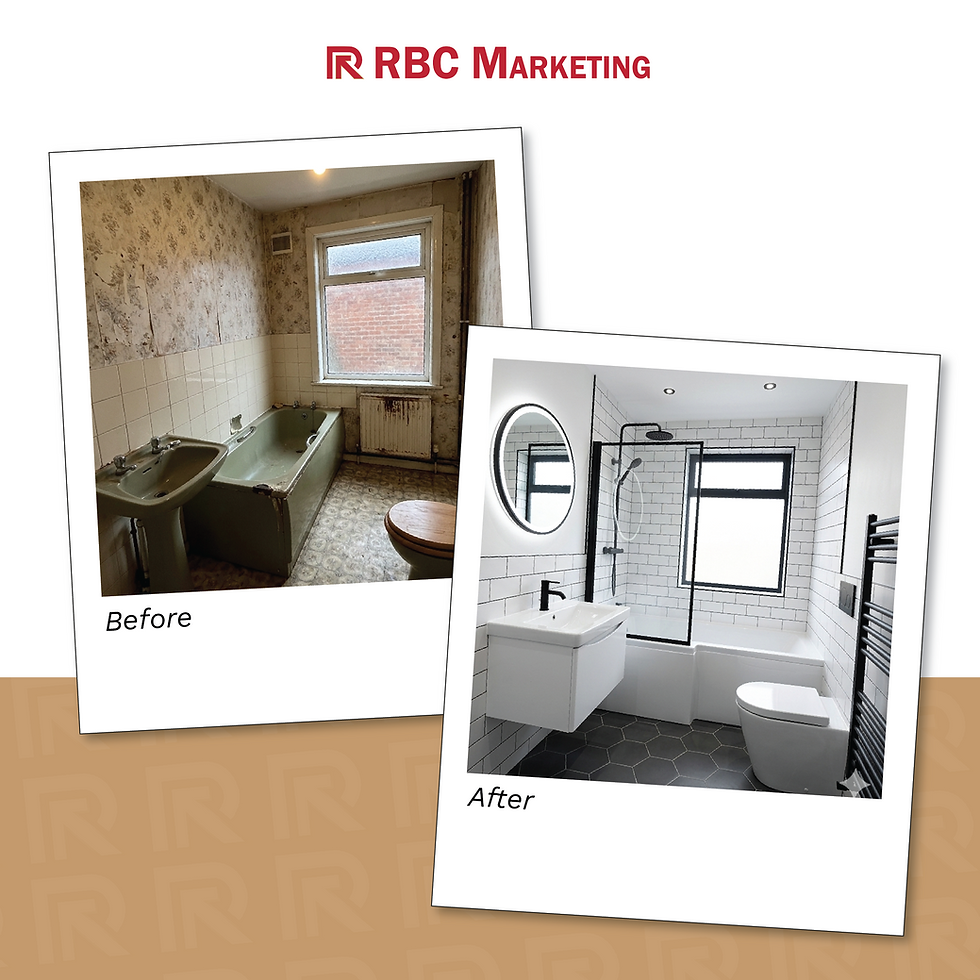
Before-and-after photographs
Work in progress
Finished projects
New team members and training achievements
Specialist or technically interesting work
Customer reviews
Awards, accreditations, and partnerships
New equipment, vehicles, or capabilities
Helpful answers to genuine customer questions
The key is to show, rather than continually tell. If you say you undertake complex commercial work, show a relevant project, and explain what was involved. If you say you have an experienced team, introduce the people behind the work.
6. Can Google and AI understand your business?
Search is changing, and more customers are using AI-powered tools alongside conventional Google searches to research suppliers. But this does not mean every business needs to chase a new technical trick or a special AI optimisation service.
The practical priority remains straightforward: make sure the web contains a clear, accurate and credible picture of your business.
Can someone quickly establish:
Who you are
What services you provide
What you specialise in
Where you work
What type of projects and customers you work with
Why your expertise should be trusted
Clear service pages, useful project case studies, accurate service-area information, customer reviews, and practical answers to common questions are valuable for people and make it easier for search engines and AI systems to understand the company behind the website.
Download the free guide
Our new eBook, “Has Your Marketing Evolved With Your Business?” gives you a structured way to review these six areas and identify what is working, what may have been outgrown and what should be prioritised next.
It is not a guide telling you to rebuild your website, post constantly on social media or chase every new marketing trend. In fact, you may go through the checks and conclude that much of your marketing is already doing exactly what it should.
But if your business has changed, it is worth making sure the outside world sees the same business you see from the inside.
Download the eBook today and take a fresh look at whether your marketing reflects the business you have built, and the business you want to become.
An online reality check
If you would like an objective view of how your business comes across online, RBC Marketing can provide a free, unfiltered three-minute Online Reality Check.
We will review your Google listing, website, and social media profiles through the eyes of a prospective customer, highlighting what is already working well as well as the areas that may be holding you back.
Email john@rbcmarketing.co.uk with your website address and the subject line “Reality Check” to request yours.
About the Author
John Wright started his career in the construction industry at Kennedy Builders Merchants in the 1980s. This marked the beginning of a 35-year journey in sales, marketing, and business development in construction.
In 2016, John transitioned into digital marketing as an it’seeze web design franchisee, before founding RBC Marketing in 2022. Today, he uses his strong knowledge of the construction industry along with marketing skills. He helps construction companies create a strong online presence. He also drives business growth through both digital and traditional marketing strategies.



Comments